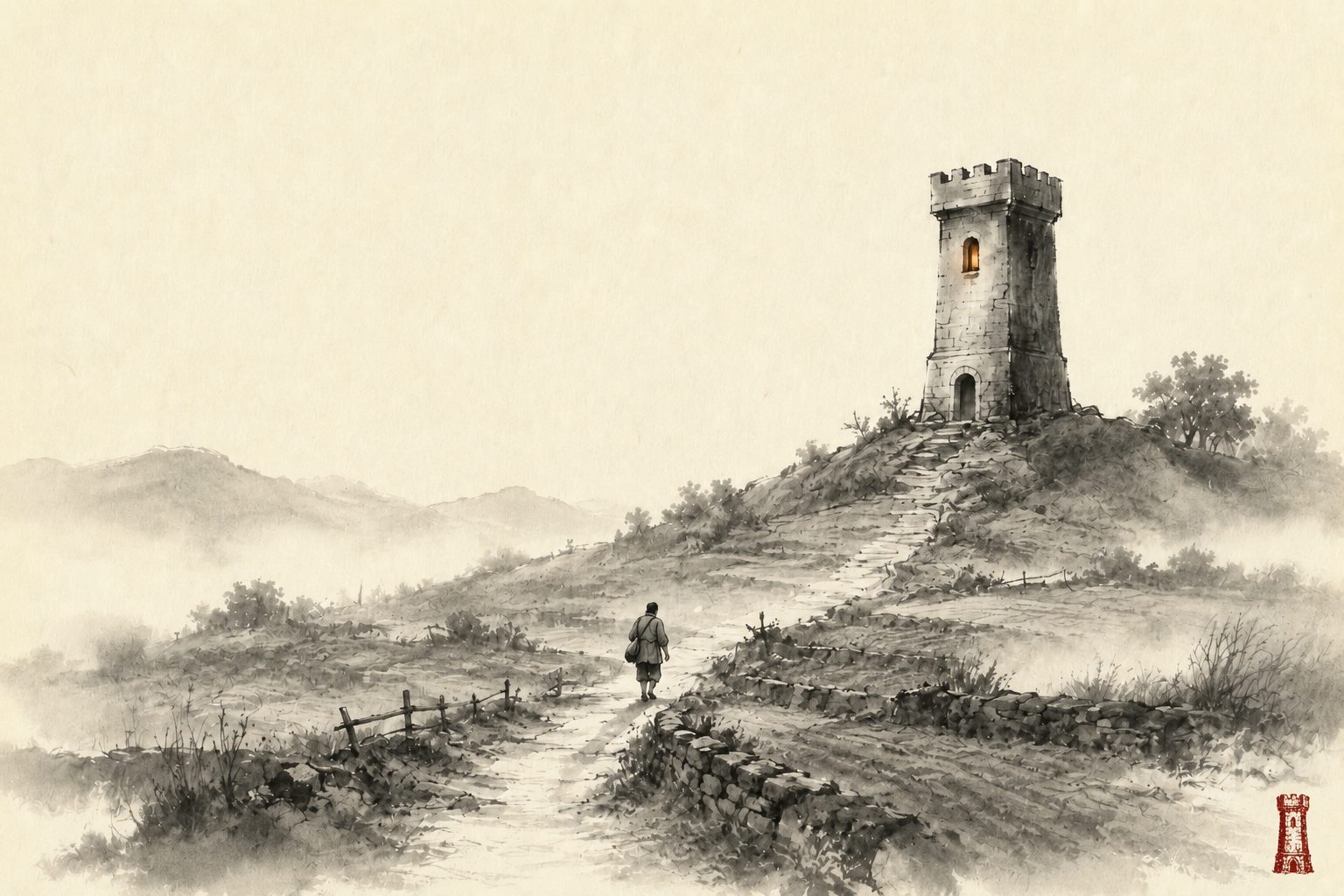
Before I publish the third essay in the Where Chaos Meets Holy Ground trilogy, I am going to take a step back to talk through some practice pointers for applying all of this to my own life. In the two essays before this one, including Weapons of Peace, I argued that the rooms in which lawyers work are holy ground, and that the weapons we are given to fight in those rooms must be spiritual rather than fleshly. Both claims are easy to admire from a comfortable distance. They are very hard to live by 9:00 on a Tuesday morning.
This piece is for the question that always lies beneath:
What does any of that actually look like on a working day?
A colleague at my firm—a thoughtful litigator wrestling with the same questions I’ve been asking—wrote to me recently in response to the first essay. She told me, candidly, that prayer often feels like an afterthought in the rush of her work, that she relies most days on knee-jerk instincts but hopes to do better when she returns from leave. Then she asked, in substance, the question I have been wrestling with for a very long time:
How does a prayer life fit into the daily decisions of practice when the blessing of abundant work has us moving so fast?
I’ll paraphrase how I would ask myself that question: Sounds great—love it. But so what? How do I make any of this practical in my day to day? Give me something real to take away.
I get it. When we talk and write about these topics, they seem so idealistic and impractical, unreachable, unattainable—except for the ascetic or one whose vocation is full time ministry and has the luxury of spirituality. But that’s not true.
I am certainly no spiritual master. I have lots of thorns I continue to work through. I am sure if you ask some of my colleagues and family members, they are less than impressed with my leadership and spirituality. I am sure not very impressed with myself. So I do not write any of this from some place of arrival. I write it from the place of a man—earnest, well-intentioned? Absolutely. Really good at it? Nope.—but one who has practiced for many years, who has prayed badly more often than well, and who has, only over the last few seasons, begun to see what a working day given over to God can actually look like.
What follows is not a program. It is testimony. Take what is helpful and leave the rest.
Five loaves and two fishes
The disposition that anchors all of this is small.
I do not believe I have what is needed. I have rarely believed it, and the years have not made me believe it more. I show up to my desk most mornings—clients to advise, hearings to prepare, motions to draft, opposing counsel to manage, deadlines that have not moved despite my prayers—with the same confession the disciples made on a hillside outside Bethsaida: we have only five loaves and two fishes (Matt. 14:17). I have only what I have. The time God has given me (less every day), talents I did not earn, experience accumulated over a career that never moved in the direction I expected, and the still-imperfect character I am very slowly being given. That is the inventory.
The miracle in that story is not that the boy’s lunch turned out to be enough. It was not. The miracle is that Jesus took it, gave thanks, broke it, and then fed five thousand. The math never mathed. The little basket did, because it was His.
So I begin most working days by handing over what I do not believe is enough to begin with, and I ask God to use it however He sees fit.
Begin the day surrendered
Concretely, this means a morning practice—not because I am disciplined, but because I have learned the cost of not having one.
I came to it by inheritance. My father woke me thirty minutes before the workday began—I was on his job sites from the age of eleven whenever we didn’t have school—and put a Bible in front of me. Just read it, he would say. I would fall asleep over it; he would come back, tap my shoulder, and tell me to keep reading. He believed the Word and the Spirit were the only instructors a man really needs. By the time I graduated high school I had read it through more than half a dozen times. None of that spared me the long detour before law school, or the seasons after it in which I prayed badly or not at all. But the bones stayed, and the working life I now keep is built, more than I knew at the time, on the foundation he laid in those daily 30 minutes before sunup.
Before the urgencies arrive, before the inbox is opened and the calendar consulted, I lay down what is mine to lay down. The deadlines and tyrannies, the hopes I am tempted to hoard and the fears I am tempted to hide, the desired outcomes I would otherwise carry around like a second briefcase, the pressing concerns others have placed on me and the self-imposed urgencies I have agreed to host on their behalf—I verbally and mentally hand all of it to God. I ask Him to take it. I release control. I say what Jesus said: “Not my will, but Yours be done.”
I begin each day in adoration of the Father, in a posture of prayerful surrender.
Only then do I open my work.
I have come to picture this in a very physical way. I see myself handing over the heavy burden I have built for myself—the weight of my obligations and hopes and dreams, and the weight of expectations placed on me by others—and receiving, by faith, the easy and light burden Jesus promised: daily bread (Matt. 11:28–30; Matt. 6:11). Most mornings, nothing about the calendar changes. The deadlines remain. The hearing is still scheduled. The case is still demanding. What changes is who is carrying it. I no longer have to figure out how to win. I have only to do what He says today and trust Him with the outcomes.
This is a harder posture for lawyers, I think, than for almost anyone else. We are paid to anticipate. We are trained to hedge. The very practice of law inclines us to gather, store, and provision against every conceivable contingency. The economic incentives of the profession reinforce all of it. And yet the manna in the wilderness was given on this principle, and only this one:
“No one is to keep any of it until morning” (Ex. 16:19).
The miracle was structured to cultivate dependence. Those who gathered much had nothing left over; those who gathered little had enough (Ex. 16:18). God could have provided a year’s supply of bread in advance. He chose, instead, to provide just enough for today, every day, for forty years.
Spiritual maturity, in our common usage, tends to mean independence—capability, mastery, self-direction. The manna lesson teaches the opposite. Spiritual maturity is codependence on God. The aim is not to grow up out of needing Him, but to grow further into needing Him for everything. We want God to provide more so that we need Him less. That is not the order of the kingdom. That is the order of the world after the fruit, after the fall.
So the morning surrender is not, in the end, a spiritual technique. It is the daily acknowledgment that I have not been promoted out of dependence, and that I do not that I no longer want to be.
Keep the line open
The morning practice initiates the day. What sustains it is what I have come to think of as a continuous line of prayer kept open through every hour of the day.
I begin the day with prayer. I end the day with prayer. And in between, I keep talking to God, all day, about the actual decisions in front of me. Which matter should I pick up first? Which email needs the careful answer and which one can wait? Should I make this call now or wait until I have the right tone? Papa, what do You want me to do next?
I pray to God as if He is sitting next to me, because He is. I ask His direction on small things and large—what to wear, what route to take to the office, when to leave for court, when to pause and step away from a draft, what to say in a difficult conversation, when to say nothing—and I do this not because I think He wants to micromanage my shoes, but because I think He cares about every detail of the life He has given me, and because to my Father even my hardest legal questions are no harder than which shoes should I wear today?
Reality, in fairness: most of the time I do not hear anything in the immediate moment. Most of the time I have to act a moment after I asked. We walk by faith and not by sight (2 Cor. 5:7), and most of the time the working lawyer’s faith looks like asking, surrendering, and stepping forward into the next decision without yet knowing whether it was the right one. I trust that if I have asked honestly and surrendered my will, He will catch me when I fall, correct me when I drift, and make even my mistaken steps count toward the good He is working out (Rom. 8:28). I see Him, in this, like a parent teaching a child how to walk—catching me when I stumble, encouraging me to try again, celebrating every small step in His direction, and loving me through all of it. Because I want to please Him, I feel His pleasure in me. The day has texture and warmth that no day driven by my own efforts has ever had.
And then a strange thing happens. Over weeks and months of asking, surrendering, and stepping, something begins to accumulate. I have come to think of it as a savings account of prayer—the small petitions, the quiet surrenders, the brief askings, deposited continually, day after day, often for nothing in particular. The returns, when they come, are unexpected, and they have surprised me more times than I can count. I have seen things happen with clients, with arguments, with hearings, with schedules, with words received and words spoken—that I cannot account for by my own preparation. Many times I have already prayed about something and heard something from God before I even knew I would need it. In those moments I already know what He wants, because we have already talked about it. I just obey.
This is not magic, and it is not formula. It is the slow fruit of a working life that has begun, very imperfectly, to take seriously the words pray without ceasing (1 Thess. 5:17). It is what happens when prayer ceases to be an event and begins to be a continuous abiding in a relationship with One who loves you. And He does. (love. you.)
There was a moment, a few seasons ago, when this began to change the way I prayed over my cases and my clients. Not that I would win. Not that I would look good. Not that I would prove my value, or vindicate my preparation, or recover my fee. But that the work itself, in its very smallest pieces, would belong to God before it belonged to me. That was the small stone, in my hand, that took the giant down (1 Sam. 17:40, 49). I am no David. But I have learned, slowly, that the boy with the sling and the brook stones knew something the men in armor did not. He knew Whose battle it was.
I will not pretend I do this well. I still falter, often, like a blind man trying to find his way in a complex world. But little by little I see Him providing a lamp to my next step and a little more light to my path (Ps. 119:105).
It is an old habit of mine to come back to the Psalms in working seasons, and to come back to them more often the longer I have practiced. As a boy I had no use for them. I told my father once that I hated them—they were too emotional. I loved Proverbs and the wisdom books—they were grounded and more useful in my estimation. He looked at me with the compassion of a man who had lived through more than his son and said, just wait. You’ll come back to the Psalms. Dad prayed for mercy more than anything else. I didn’t understand then. I do now.
The Psalms are my best friend now. The working life has a way of turning a person toward the literature of weariness and longing and then praise after weariness—and they are the Father’s gift to those who keep walking. The echo the priestly calling we were given but most have lost. An audience of One. It is all for Him.
When you fall, get back up
A theology of working-day prayer, if it is going to bear weight under the actual conditions of legal practice, has to make room for failure. Because we all fail. I fail. I forget to surrender. I grasp for the fruit again, because it looks good and like what I need right now. I miss what He was saying, or I hear it and act in the opposite direction. I lose my temper at home over something that started in the office. I let the urgencies of an afternoon overrun the morning’s quiet. I become the man who was right in his own eyes (Judg. 21:25)—usually right around four o’clock.
What I have come to depend on, more than my own consistency, is something I find articulated more clearly by Paul than by any contemporary teacher: “it is God who is effectively at work in you, both to will and to work for His good pleasure” (Phil. 2:13).
The longer I practice law as a Christian, the more I find that the strength, passion, ability, and resolve I would have once said the work required are not, finally, what carries me through.
None of this is by might or by power, nor by my ability, ingenuity, intellect, motivation, or manipulation. This work is done only by the Spirit of Almighty God (cf. Zech. 4:6).
That is good news for the person who has run out of strength, and for the one who privately suspects he never had enough to begin with. It does not excuse apathy. It does not give license to drift. But it provides the way back into the Father’s arms when I have wandered, and again, and again . . . and again. He is not surprised by my falls. He is glad when I get back up—when I rebel against my fleshly sin nature, weak and fragile and impotent though I may be.
And so the operating image of all of this, for me, is the parent teaching a child how to walk. The child is not graded on his form—I mean, of course we get better the more we practice. But in the beginning, it isn’t pretty. The child is celebrated for taking the next step. When he falls, the parent does not abandon or become angry with him. (why do we think God is angry when we are trying to serve Him?!) The parent stoops, lifts, and sets him back on his feet, and the child trusts because he is loved—he doesn’t even question it.
That is the picture of how I am meant to live the working day. The standard is not perfection. The standard is taking the next step, in His direction, in His sight, by His hand. And I know He loves me.
How then should we walk it out?
A few practical pointers, then, drawn from this and offered as an invitation rather than a program:
Begin the day surrendered, before the urgencies arrive. Do this verbally if you can. Lay it down—the deadlines, the desired outcomes, the hopes and fears—and exchange the heavy burden for daily bread. If you wait until you feel ready, you will not begin. Say,
Father, I give you my day. This is the day that you have made. I rejoice and am glad to be living. Direct my steps today—my thoughts, emotions, words, and acts. Be glorified in this day and help me to hear and quickly obey every word that you speak. Amen.
Keep the line open through the day. Pray about which matter to pick up first. Pray over emails before answering them. Pray over phone calls before placing them. Pray walking from your office to the courtroom, the conference room, the breakroom. Treat your Father as if He cares about the small things, because He does.
Walk by faith when no answer comes. Most of the time you may not hear something in the moment. Ask, surrender, then step. Trust that He will correct you if you have drifted, and will bless what you have offered honestly. You are not graded on your hearing. You are loved through your stepping. Just take the next one.
Let prayer become a savings account, not a transaction. The point is not to extract a particular outcome from a particular prayer. The point is the relationship, deposited continually. The fruit will come, in time, often before you knew you needed it.
Receive your failures as a child receives them. When you grasp again, when you forget again, when you let fear or pride retake the wheel—just get back up. Acknowledge. Repent. Keep your eyes on Jesus. Allow Him to restore you. Take the next step.
Take up the ministry of Jesus when you walk into your office. When you come on the scene in Christ, fully clothed with Him, you are not merely a lawyer who happens to be a believer. You are an ambassador, a witness of the Most High, a son or daughter of the living God, and the work of Jesus continues through your hands. Ordinary work, prayed through, becomes sacred work. The desk becomes an altar. The client interview becomes a quiet act of intercession. The hearing becomes the holy ground we have been speaking of all along.
— — —
A final word. If you are like the colleague, my friend, whose question shaped this essay—fierce, capable, faithful, exhausted, uncertain, in seasons of life that are physically depleting—please do not hear any of this as one more thing to do. Hear it instead as one more thing to receive.
God knows where you are. He sees what you are enduring. He is not standing apart from your day waiting for you to deserve His attention. He is in your office, your room, your home—right now, longing to be invited into the next decision, the next call, the next email, the next breath. Begin, if you have not begun. Begin again, if you have stopped. He is patient with how slowly any of us learns to walk. He is not angry with your flawed efforts. He is encouraging you to take the next step.
He sees you. He knows you. He is building something in you, and through your family, that will carry weight for generations.
He. Loves. You.
— — —
Michael C. Kelley is a Florida attorney and shareholder at Lawson Huck Gonzalez, PLLC. He writes at Turris Fortis on faith, justice, and the practice of law as peacemaking — not the kind that confuses peace with avoidance, but the kind that contends for it with the weapons God supplies. Turris fortis mihi Deus — Prov. 18:10.
It stands beside a continuing series of essays, best read in order — Start Here has the full map.