I need to write a Part 2 to the Alabaster Jar article. I admire Mary because she “got” it. When she broke her jar for Jesus, she had already been broken of self. As I ponder that article today, I have to wonder, “What does it take for me to be broken?” This second essay is my answer to that question. And it begins with Waiting.
My soul waits for the Lord more than watchmen wait for the morning; more than watchmen wait for the morning. — Psalm 130:6
— — —
Waiting on God is active; it is not passive. It is not sitting around waiting for something to happen. It is not doom-scrolling or playing video games, and it is not sleeping the day away while you hope something good happens. Neither is it going about your normal business with the mentality that if God wants to do something different, He knows where to find me. It is not apathy, and it is not stoicism—both ditches of pseudo-intellectual passivity that many fall into. Rather, it is digging for buried treasure where you have some idea, but cannot be sure, of where it is hidden. It is seeking the one pearl of great value, worth more than everything else you own combined. It is pouring over scriptures and prophecies and star charts like Magi waiting for a Messiah not yet born. It is the mother waking early, at 3:33 a.m., to pray for the family and the loved ones who desperately need Him. It is the father rising hours earlier than he has to, to seek the Father in quiet and stillness.
And contrary to all the common sense of the world system, it is the most productive and dutiful thing a person can do. There is no better expenditure of a life than the hours spent in solitude, waiting upon Abba. It is hard work, the stuff of warriors. Playing games, exercising, eating, sleeping, running the day’s errands—these are easy. Some necessary. Others excuses and abdication. But even hard, visible, productive, spend-yourself labor is easy, in its way, because it feels like you are doing something worth doing. Waiting on God is the harder work, and the more significant: grueling, Gethsemane labor—sweating drops of blood, crushed under the weight of all that depends on you, all that waits on you to move. And yet you sit in the silence, and still you wait. It is wrapping your arms tight around the leg of the Father and refusing to let go—believing He is carrying you where you would never dare to tread alone, on your own strength, by yourself. There is no better use of your time, your life, your breath than to wait upon the LORD.
I feel I have spent my life waiting, but often not very well.
— — —
The protest
There is a sentence in the Psalms that I have seldom been able to obey without first arguing with it. Be still, and know that I am God (Psalm 46:10). The instant I read it, a second voice answers—the voice of the reasonable, professional, exquisitely well-trained man—and the voice says: Still for how long? What about your work, your responsibilities, your obligations? What about everyone who is counting on you? Unless you stop being too heavenly minded to be of any earthly good, people you love will starve.
The questions are not wrong, exactly. In the natural order, they are even commendable. They are the questions of a man who has been entrusted with things—files, deals, a firm, a family, the literal liberty and fortune of clients who pay him to never, ever sit still. The lawyer is hired precisely because he will not wait. He will not let the silence sit; he fills it. He does not abide an unanswered letter; he answers it. He is the one who moves while others freeze, who acts while others deliberate, who is paid by the hour to do something. Stillness, to a temperament like this, does not register as obedience, but as malpractice.
So when God says wait, the trained man hears abandon your post. And he refuses—out of what he is sure is faithfulness, but is more often fear wearing faithfulness as a robe. This is the first thing I had to learn: that my reflexive busyness was not the opposite of sloth. It was sloth’s respectable twin. Both of them are ways of refusing to wait on God. One refuses by doing nothing. The other refuses by doing everything.
— — —
The counterfeit
The enemy does not usually fight a command head-on. He counterfeits it. He cannot stop you from waiting, so he sells you a fake wait and lets you congratulate yourself on your patience while you starve.
Watch how he did it in the wilderness, because the three temptations of Christ are, every one of them, temptations of a man who is being made to wait (Luke 4; Matthew 4). Turn these stones into bread — that is, do not wait for the Father to feed you; provide for yourself; you, and your family, have to eat, don’t you? Throw yourself down from the temple — that is, do not wait for the Father to move; force His hand; if the present is not the mission, then jumpstart the mission, hurl yourself into danger and obligate God to show up and show off. Bow down, and all the kingdoms are yours — that is, do not wait for the Father to give you the inheritance He has promised; take the shortcut, without the pain and death of the cross; bend the knee to a lesser power and have it now, quick and easy. Self-provision, forced timing, the idolatrous shortcut. These are the three faces of impatience. These are how the world, the flesh, and the devil get you to sell your soul.
I have turned stones into bread and called it diligence, being a faithful steward. I have flung myself off cliffs and called it stepping out in faith. I have bowed to things I would never have named as gods, because they offered me a faster route to a thing God had already promised to give me slowly.
There is a subtler counterfeit still, and it is the one that besets people like us most—the responsible, the competent, the dutiful elder brothers of the world. It is the waiting of the good Christian man. Many have worn that title in their own way. The Pharisee of Jesus’s day was, in his own mind, a man who waited on God; he was biding his time, keeping the law spotless, holding himself in reserve for the day the Messiah would come and hand him the keys to the Kingdom. But it was not waiting. It was a holding pattern with the eyes fixed on the self—a shadow government assembling in the dark, rehearsing for the moment it would finally be put in charge, when all the nations of the world would finally be blessed under his self-righteous rule.
That is not the posture of a servant watching for his Master. That is the posture of a usurper checking his watch. And it is terrifyingly easy for a serious Christian professional to slide into it: to treat the whole of this life as a green room before the show, to keep ourselves credentialed and politically spotless and ready to rule, mistaking ambition held in escrow for faith.
None of these is the real thing. Real waiting does not provide for itself, does not force the clock, does not take the shortcut, and does not stockpile power against the day it gets to be in charge. Real waiting keeps its eyes off itself entirely. And that, it turns out, is the one thing the counterfeit can never do.
— — —
The plateau
I know the difference because I embraced the counterfeit for years and called it the summit—the Western man’s normal Christian life, the one who did not bury his talent.
I had done, I thought, the hard thing. Somewhere back in my younger faith I had come to the genuine end of myself and prayed the genuine prayer: LORD, I cannot do this on my own; I cannot do it at all; take my life and do with me as You will. And He took it. I laid it down and He picked it up. He opened doors I had not knocked on and carried me into rooms I had not earned. And I concluded, reasonably, that I had arrived. I have reached the plateau, I told myself. I am where God wants me. I have given Him the one thing He asked for—complete control. I am sold out.
But He wanted more. Not more striving. He wanted me, the part of me still standing just behind my own surrender, watching to see how the surrender would pay off. So He let the rain stop. The doors that had swung open now swung shut. The sense of His nearness thinned to nothing. And I did what a dutiful man does in a drought: I worked harder at waiting. I rose earlier. I prayed longer. I poured myself out—and still nothing came, and I cried the only honest prayer I had left, which was not a prayer so much as a complaint with a verse attached: What more do I need to do? I know not what else to do. I can only keep pursuing You, because I am otherwise lost—too far gone to be of any earthly good; not far gone enough to be of any heavenly good.
It was in that season that I sat down with my father’s old notes—pages he had written eleven years before, three and a half years before he was gone—and read his hand making the very promises to himself that I was making to mine. And the thought rose up: Dad believed all of this, too. Did any of it ever come true for him? In the years that have followed I had earned the right to ask the question that Job and his friends asked, and I asked it with boldness. Does God perform His Word, or do we just die holding it?
What I heard back was not consolation. It was correction, and it was this: There is a generation that will see it. It may not have been your father’s. It may not be yours. But My Word is true. I perform it—you do not. And I am not on your timetable.
I had been doing the thing I am trained to do, the thing that pays my bills, the thing I cannot stop doing: I had been judging God by the evidence in front of me on this particular afternoon, rather than by everything I already knew to be true about His character. I was reading the present circumstance like a closing statement, when it was only a line of testimony in a trial God had not yet rested.
That is what the plateau is for. It is not a reward for arriving. It is the place where God reaches in and removes the last thing your surrender was still hiding—the watching, weighing, calculating self that had agreed to give Him everything provided it could keep score. Watchman Nee said it more plainly than I can: what we most need to be delivered from is not our circumstances but our selves; God lets the trial sit on us not to break the situation but to break the one inside it who will not stop looking at himself. The drought was not God withholding. It was God operating.
— — —
The turn
The thing that finally moved was so small I almost missed it.
In one of my worst dry seasons, I had taken to going to an empty church building in the middle of the day and praying for an hour on the floor—pressing in, asking, seeking, knocking, demanding answers with Scripture in my fist like a brief. And one day I walked in and simply did not feel like praying. I felt like going to the piano. So I did. I played before God alone for an hour. The next time, I prayed. The time after that, I played again, or I lay flat on the ground, or I did things I had never done before and could not have explained. And still — still — no answer came to the question I had been hammering on, until I heard from someone, not even talking to me, that two of the most important things a Christian can do are worship and intercession. And the whole locking mechanism began to turn over.
Because here is what I had been doing wrong, after I had done everything else right. I had laid down my life. I had picked up His desires. My heart was, as far as I could tell, genuinely His, without guile. But the eyes were still on me. Every hour of that fierce, sincere, sweating prayer had been, underneath, a prayer about myself — what do I lack, what must I do, when do I get the answer, why am I still here. And the Father was not saying try harder. He was saying: Take your eyes off yourself and put them on Me—that is worship. Take your eyes off yourself and put them on others—that is intercession. You have asked, and sought, and knocked, and that was right; now set all of it down and just look at Me.
That is the secret hidden inside the command to wait, and it is why the command is active and not passive. To wait on God is not to suspend the work. It is to be relieved of the only work the self ever really wanted to do, which is to manage its own outcome. What is left, when that is taken away, is not idleness. What is left is the two most strenuous and least self-interested acts a creature can perform: to adore the One in front of you and to carry the one beside you. Eyes up. Eyes out. The waiting room turns out to be the one place on earth where it is impossible to be selfish, because the self has nothing left to do there but die.
F. B. Meyer wrote that the manna only ever fell where the cloud of God’s presence was brooding—that the food was certain to be found on the very ground that, an hour before, had been bare. The waiting is not the absence of provision. The waiting is standing under the cloud until the bread comes down. And he wrote, too, the sentence I have leaned on for years: that God is already in our tomorrows; that He is down in front, the way a shepherd walks ahead of the flock; that all the tomorrows of our life have to pass Him before they can ever get to us. The thing you are waiting for has already been to see the Father. It cannot reach you in a place of self-preservation. That is why you can sit in the silence without panicking, and why the silence is not empty.
— — —
The reward
There is a promise at the bottom of all this, and it is the one every weary person already half-knows by heart.
He gives power to the faint; and to those who have no might He increases strength. Even the youths shall faint and be weary, and the young men shall utterly fall: but they that wait upon the Lord shall renew their strength; they shall mount up with wings as eagles; they shall run, and not be weary; they shall walk, and not faint (Isaiah 40:29–31).
Read it slowly and notice the scandal in it: the strong fall, and the waiting fly. Not the busy. Not the gifted. Not the ones who turned the most stones into bread. The one who waits. Strength is not what you bring into the wait; it is what the wait does to you.
I waited patiently for the Lord; and He inclined to me and heard my cry. He brought me up out of the pit, out of the miry clay, and He set my feet upon a rock (Psalm 40:1–2).
The lifting is on His end. The waiting is on ours.
And the highest reward is not even the renewed strength. It is what the strength is for. When the risen Christ had finished His work and was about to leave His friends, He did not send them out. He told them to wait—remain in the city until you are clothed with power from on high (Luke 24:49). They had the commission already; they had seen the resurrection with their own eyes; every instinct a competent person has would have sent them running into the streets that morning. And He sat them down to wait. Because the work He had for them could not be done in their own strength, and the only way to receive His was to stop generating their own long enough to be filled. The wait was the antechamber of Pentecost. It always is. The swept house is not left empty for nothing; it is held open, waiting, until the Spirit comes and fills it.
This is the part the world will never “get,” and we should stop expecting it to. We are not called to climb back into the boat and ride out the storm in something seaworthy and sensible. We are called to do the absurd thing—to step out onto the water at His word (not our own initiative), and to wait there, on a footing no engineer would certify, for the only One who can hold us up. It will not look efficient. It will not look prosperous. It will not look wise. It will look, from the shore, like a man standing still while everyone else rows. But the man standing still is the one wrapped around the leg of the Father, going exactly where the Father goes and nowhere else, and there is no safer place in all the world to be.
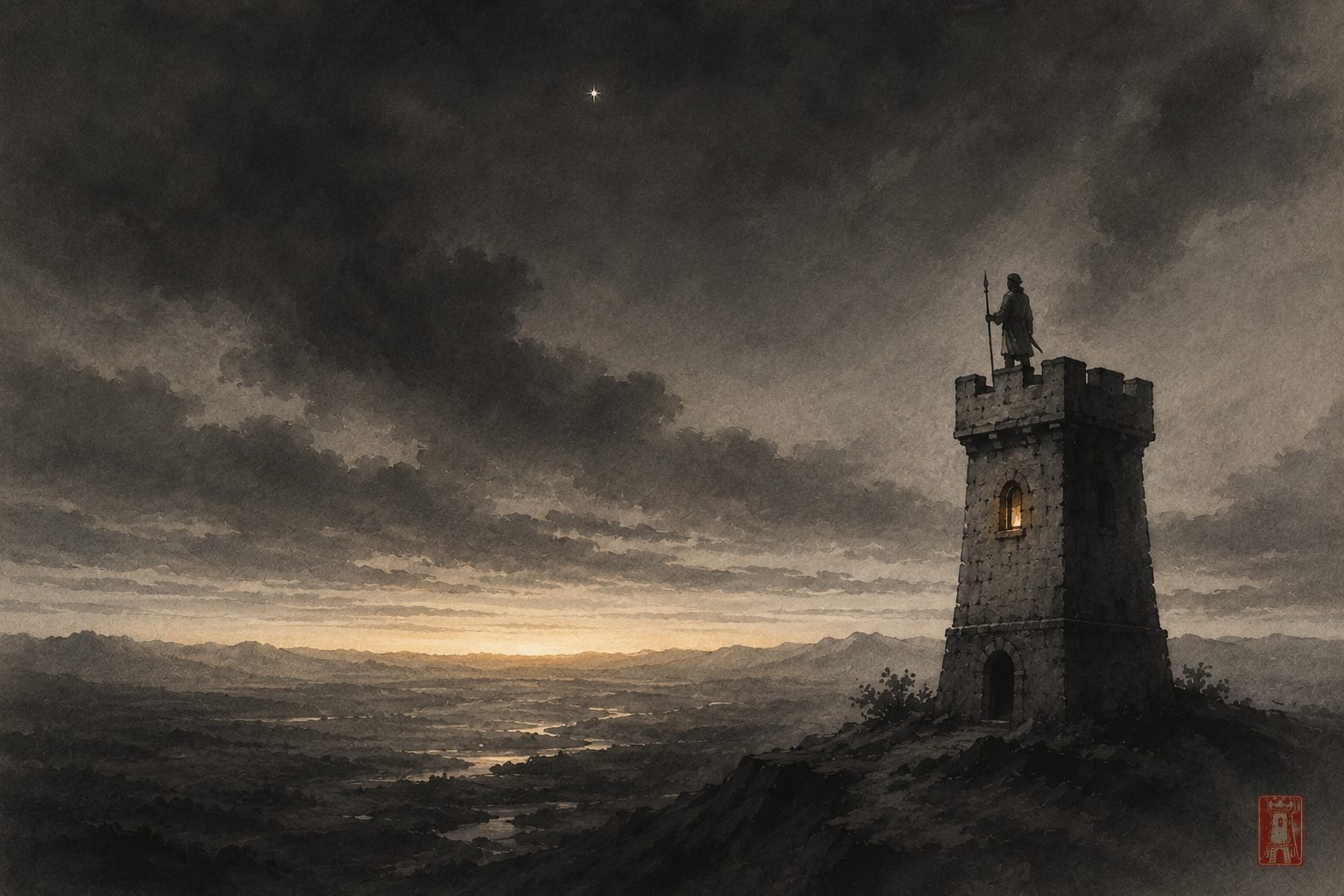
So wait. Not the way the dead wait, but the way the watchman waits—awake in the dark, leaning toward a dawn he cannot yet see but has been promised, more sure of the morning than of his own eyes.
The Lord is good to those who wait for Him, to the soul who seeks Him (Lamentations 3:25).
Seek Him at the third hour of the morning when the house is silent. Adore Him when you would rather be solving something. Carry the people He has given you on your back into His presence and lay them down there. And when the rational, professional, exquisitely trained voice rises up to ask how long, and what about your work, and who is counting on you—answer it honestly. Tell it that this is the work. Tell it that you have never been more on duty in your life.
Because waiting on God is not what you do before God acts. It is what God does to you while you cannot.
— — —
Michael C. Kelley is a Florida attorney and shareholder at Lawson Huck Gonzalez, PLLC. He writes at Turris Fortis on faith, justice, and the practice of law as peacemaking — not the kind that confuses peace with avoidance, but the kind that contends for it with the weapons God supplies. Turris fortis mihi Deus — Prov. 18:10.
This is part two of the fourth essay in a continuing series, best read in order — Start Here has the full map.