The world has a smell. We are born into it, and never notice. The way a fish has no idea it is wet. It is the smell of striving and keeping score, of measuring and being measured, of eat-or-be-eaten and take-what-you-can and only-the-strong-survive. We wear it our whole lives. We wear it to church. We wear it into the office and into the courtroom, the boardroom, the funeral of a cherished loved one. We have worn it so long that we mistake it for something else—competence, seriousness, respectability, a man who has his life in good order. I wore it like the rags of my own righteousness for years trying to make myself into that witness of God I wanted so desperately to be, that image of a man wholly given to the LORD, that example to others of THIS is what it means to be a “good Christian.” I worshiped my own image of righteousness, my faith, my obedience, my godly moral character. And to describe it as an unpleasing aroma would be too generous. It was putrid, the smell of the world.
There is only one way it comes off.
You have to be broken.
A woman walked into a house in Bethany carrying a sealed jar of pure nard—a year’s wages worth, perhaps the one thing of real value she owned. And she broke it. Not opened it to dabble what could be spared. Broke it, spilling it in an act of sheer waste. The word Mark uses is the word for shattering. She snapped the neck of the thing and emptied the whole of it over the head and the feet of Jesus and wiped His feet with her hair. And the house—and His soon to be beaten and crucified body—filled with the smell. Every person in that room was suddenly standing inside a cloud of something they had not chosen and could not stop. She did not pour out a little and keep the rest for a more deserving day. She destroyed the container, so that nothing could be held back, and the fragrance went into the curtains and into the beards of the furious men around the table, and it would not wash out for days.
We have been taught to see this as an act of worship, and it is. But worship is what came out. It is not what happened to her. What happened to this woman, this true witness of Jesus, is that she had finally been set free—free from every measure and logic and process of the world. Free from her not-so-velvet cage of existence, and free from her own hopes and dreams and expectations and good stewardship of having saved up such a treasure to begin with. And the breaking of her jar was how the rest of the room found out, of how she was broken and freed from her prison.
The jar is you
I had it wrong for a long time, and the wrongness is worth explaining, because it is the comfortable man’s mistake. And I have had been a comfortable man. I thought the alabaster jar was a possession. A thing she owned and gave up. The expensive thing surrendered, the sacrifice made, the line item moved from her column into His. Read it that way and it stays safe, outside of you. It becomes a story about generosity, and you can admire generosity from across the room without any of it touching your skin.
The jar is not a possession. She is the jar.
The jar is you. It is the whole of what you have made of yourself—your name, your record, the version of you that wins, the man or woman other men and women respect, the conception of who-you-are that you have spent thirty years building and would defend to the death because somewhere along the way it stopped being something that you have and became the thing that you are. You are the jar. And God’s whole design, written into the dirt of the world from the beginning, is that the jar has to be broken before anything of true value can come out.
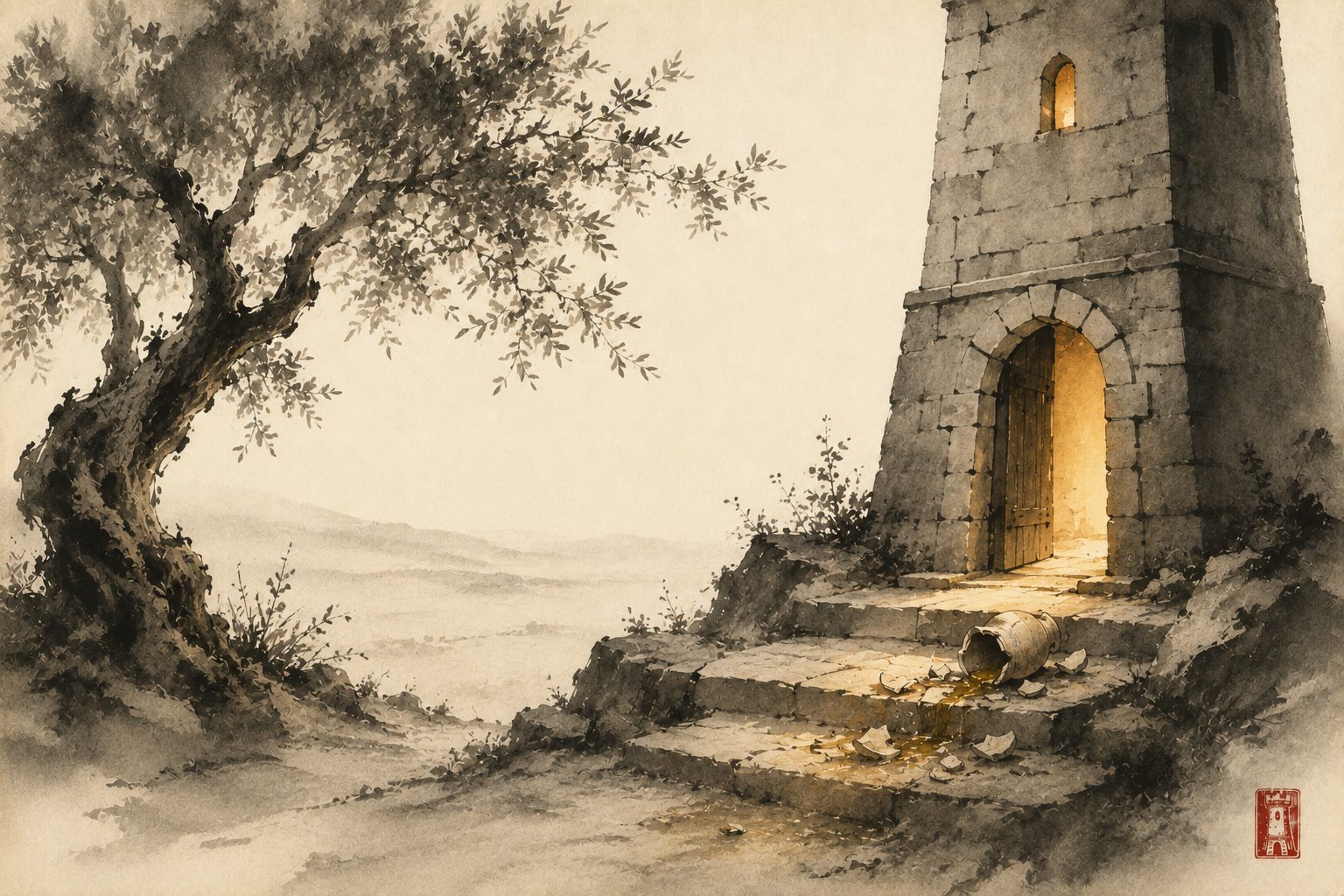
He hid the lesson everywhere so we could not miss it. The olive is beautiful on the branch and useless; it gives nothing until it is crushed, and then it gives oil. Oil for the lamp, oil for the wound, oil for the head of a king. The grape is also lovely in the bunch but gives nothing until it is trodden and ruptured, and then it gives wine. The grain of wheat is gold in the field and feeds no one standing up; it has to be cut down, threshed, ground to powder, mixed and kneaded and put into the fire, and only then, broken and crushed, does it become bread. There is no oil without the press. There is no wine without the winepress. There is no bread that was not first a seed that died and a kernel that was crushed. God did not arrange creation that way by accident. He arranged it so that when the time came for Him to be crushed Himself, and for you to be crushed along His side, we would have spent our whole lives surrounded by the reason.
We are jars of clay, made to be broken. We are the olive and the grape and the kernel of wheat. And the fragrance that the world calls waste is the only thing any of us was ever made to give. You are not your own. You were bought with a price. Made to be a fragrance, an incense offering, a sweet aroma unto the God of all Creation.
The years in the belly
I cannot write the rest of this honestly without telling you that I know about the breaking from the inside, and often fought it. It’s not fun to be broken.
There was a season, years ago now, when everything I touched seemed to be blessed. I rose early to pray over my business and the favor came in like a tide. Sometimes maybe I confused the tide for something I had done or deserved. Then it was taken. A financial collapse I did not see coming and could not stop turned an owner back into a nomad. After that the years run together the way they do in a wilderness—law school, another country, a miscarriage, then another, a place that felt like a pit, then one that felt like Potiphar’s house, the slow education in betrayal that a certain kind of partnership gives you, the discovery that I could be the one betrayed and also, God help me, the one doing the taking from people who were not strong enough to keep what was theirs. My father died. My sister died. My mother died. Somewhere in there I sat at a beautiful resort among partners during a year my work was failing, surrounded by men I was sure despised me, and I wrote to God that I felt I did not belong and could not tell whether He had set the table for my good or set me down in the presence of my enemies. I had stopped knowing how to pray. I had stopped knowing what to ask for. I had stopped hearing His voice. It felt so dark.
Here is the part that shames me most. God had brought me into rooms as a gift, and I had decided that I was the gift. I thought I was the instrument that mattered, when I was only ever a tool that had to be made fit for the Master’s hand. A hammer does not swing itself. A chisel takes no credit for the shape that comes off the stone. The whole temptation, the original one in the garden, was the offer to be your own god, your own savior, the one who provides for himself and rescues himself and does not finally need anyone. I had taken the offer without ever once admitting I had taken it. I had a Bible on my desk and the offer in my heart at the same time, and I could not smell it.
What I called a dark night, and a storm, and a being-swallowed—Jonah in the belly of the thing, sinking, certain God had forgotten—was none of those things. It was the press. I was the olive, and I was being crushed. I was furious about it, and was sure it meant God had withdrawn—when in fact, it was the most attention He had paid me in my life. He was not absent. He was pressing. He withholds because the withholding is the mercy. He takes the tide back out because the tide had become a wall between us. He lets the owner become a nomad because it is hard to follow and move from a castle. The nomad has little choice. I did not like being a nomad. I did not appreciate having things stripped away, being pruned—having weeds and rocks torn out of me. And I did not understand a word of this while it was happening. I understand a little now, with the oil just beginning to seep out. I am telling you all of this because those I most want to reach will recognize the press even if they have not yet seen it for what it is. It is breaking, crushing—a death—that produces oil and wine and new life.
The ones who would not break
There were others standing at the same threshold she stood at, in other rooms in the Book, and they did not break. I have been or met every one of them.
A husband and wife in the early church sold a piece of property and brought the money to the apostles and laid it at their feet, exactly as a generous man named Barnabas had just done. The form was identical. The posture was identical. The difference was that they had kept part of it back and said they had not. Peter does not rebuke them for keeping it—he tells them plainly the money was theirs to keep, all of it, none of this was required. He rebukes them for the lie, and the lie is the worst lie a person can tell, because it was a lie about being set free from the world when that had not happened. It was a lie about the work of the Holy Spirit in their lives, delivering them and calling them into service, when He had not. They were trying to buy access and position and status in the early church, faking a move of the Spirit that had not occurred. This was unpardonable. Barnabas’s gift was smoke that proved a fire. Ananias and Sapphira wanted the smoke without the fire—the opportunity to speak without having experienced the burning coal on their lips. They wanted the church to smell deliverance on them while they kept the cherished portion locked in a back room of the heart where no one could see it was still theirs. They didn’t burn the boats and abandon all hope of return to Egypt. They held back a safety net, just in case this didn’t work out, just in case they needed a little something extra when sharing everything else with the Body. They wanted to be thought broken and delivered and set apart by God, without the inconvenience of being crushed. And they fell down dead, both of them, because you cannot fake the one thing that is the true difference between life and death. I have brought God a portion and called it everything more times than I can count. (O, my God, have mercy on me, a sinner!) I have stood in the posture of the surrendered man with the real thing still held back. The reason the story frightens me is that I have lived it. Sometimes I fear I still live it. (Selah)
A woman dragged by the hand, out of a city God had sentenced, set down outside the walls, told one thing — Do not look back. But she did look back. She had been delivered in body but not in heart. The city still had her, even with her feet already on the road escaping judgment. And the look over the shoulder was her heart refusing to let go of the things she treasured most, even above her own life and family—the status, the home, the friends, the life, all that she truly held dear. Deliverance from the world had never actually happened inside her. She did not let the place go, so when the leaving came, the place had her still. She stood there at the edge of her own rescue and became salt. I know that backward glance. Have walked out of things God plainly delivered me from with my head turned the whole way, grieving what I was being saved from, smelling of it long after I had supposedly left.
And then the careful, immaculate men—the spiritual leaders of their day. The ones who had mastered all the behavior. They did not drink, did not curse, did not chase the obvious sins; they tithed the herbs in the garden down to the leaf. And the Lord’s hottest anger in all the Bible falls on them. It has taken most of my life to understand why, because their conduct was so much cleaner, their character so much better than mine. It fell on them because they had never come out of the world’s system into the true Kingdom of God. Worse, they had learned to win at it, to thrive in it, to flourish in the world of their making. They recognized the cell, but rather than escaping it and helping others do the same, they papered the walls with the velvet of a good moral life, faithfully following Torah and congratulating themselves for their righteousness. They served themselves lavish dinners inside the prison and called it the work of God. They coveted the things of God, more than knowing Him, and gorged themselves on food meant to be shared. And the most egregious thing was not that they sat comfortably in the cell content with the lives they had built apart from the Father—it was that they shut the door on every prodigal trying to return to Him. They would not go out themselves, and would not let anyone else go either. They loved the smell of the world. Lied to themselves and called it holiness. It was putrid—like a beautiful sepulcher containing a rotting corpse.
I will say the obvious thing, because those I am writing to will not say it about themselves and I have to say it about myself first. The legal profession is one of the most comfortable cells ever built. The bars are upholstered with fine crushed velvet. The food is epicurean and arrives on demand. They do not throw us to lions anymore. There is no need. When the partnership track and the verse on the wall and the family photo on the desk and the respectable margin will do the same work without the mess. The enemy stopped persecuting this church long ago. It is cheaper and easier to keep the inmates fat and call them free.
How many of us are current inmates, asking for seconds, not even knowing there is a door out?
Before the body is gone
Back to my favorite witness of Jesus: Mary. The heroes are not, first, the men: those who betray Him and deny Him, flee from Him—leaving even their dignity and clothes to save themselves—later hiding in an upper room afraid to show their faces. The hero is, first, a woman—and one who didn’t even have the best reputation among them.
Mary “got” it. She came beforehand, when there was still a moment in time—before His betrayal, torture, and death. As Jesus said, She is come aforehand to anoint my body to the burying. It is one of the most piercing statements in the Gospel and almost no one notices it. Mary is the only person out of all His disciples, all those we revere and glorify today, who actually listened to Him, understood what was happening, and anointed the body of Jesus for burial. The other women came on the morning after the Sabbath with their spices, loving Him, fully intending to do the thing—were too late, because He was not there. The grave was empty and the spices went home unused. The moment for the anointing was while the body was still in the room, and exactly only one person in the whole story stepped through it. She was the one the men were calling wasteful, lazy, sitting at His feet instead of doing something useful. They would have prevented her from fleeing the prison, but she would not be held.
We are people of after. After it is too late. We will pour out our lives on God after the children are raised. After the practice is steady. After the loans are gone, the calendar finally clears. After we have built enough that we have something of significance to give. The whole architecture of after is the architecture of a man who has not yet been broken—because deliverance is not a thing you schedule for a more convenient time. It happens while the body is in the room, and the body is in the room only for a little while. The clients in the office, the wife across the table, the children in the house, the partner across the conference room, the case that came in this morning—the Holy God is with me in this moment. Will I not consecrate and pour out my whole life on Him now? There will not be a tidier, clearer, more appropriate moment.
Gethsemane
Here is what John does that I had read past for thirty years. He sets Mary’s broken jar down in the twelfth chapter, the house still full of the smell of it—and within the same breath, the same chapter, Jesus opens His mouth and says, Except a grain of wheat fall into the ground and die, it abideth alone: but if it die, it bringeth forth much fruit. And then, Now is my soul troubled. He watched a woman crush a jar and pour herself out, and He turned and told the room that He was the kernel of wheat about to be put in the ground, the One about to be crushed for real.
Her breaking was a symbol. His was the substance.
He went to Gethsemane—a garden whose name means the press of oils, the place where the olives of that hillside were crushed for their oil—and in the press named for crushing He was crushed, until the sweat came off Him like blood falling to the ground. It pleased the LORD to bruise him. Can you imagine?! He was the olive in the press, the grape in the winepress, treading it alone—He drank the wrath meant for me. And the wine that came out of Him is the cup we still drink. He was the grain of wheat that fell and died and rose with the whole harvest in His hands, and the bread that came out of His breaking is the bread we still eat. His body, broken for us. His blood, shed for the remission of our sins. The perfect Passover Lamb.
This is where the comfortable lawyer needs to hear the only good news there has ever been, because the breaking I have been describing is more than any of us could survive on our own. We follow Mary into the press, yes. But Mary herself was only following Him. He went first, and He went all the way down, into a crushing that would have annihilated us, and He did the part we could never do. He broke the thing we could not break. Our breaking does not earn anything and does not need to. He has already done the only breaking that pays. Ours is the small, derivative, grateful crushing of people who have been carried through the press in the body of Someone Else—my Jesus!—and come out the other side smelling, for the first time in our lives, not like ourselves, and not like the world, but like Him.
What pours out
When a life like that has been broken, what fills the room is not the noise of the breaking. It is the smell. And the smell is not the man. Watchman Nee, whose reading of Mary in his last chapter of The Normal Christian Life, which I have leaned on here and will not attempt to improve, put it as plainly as it can be put: the principle of waste is the principle of power. The life that looks most squandered to the careful religious man is the only life that has ever changed anything, because what runs out of a broken vessel is not the vessel—it is whatever the vessel was filled with. Fill it with the world and break it and you get the world. Fill it with God and break it and the room fills with God.
The Lord asked once whose face was stamped on a coin, and they said Caesar’s, and He said then give it back to Caesar—it is his, it belongs to his economy, send it home. And on the man stamped with the image of God the same logic falls with terrible weight: give the God-stamped thing back to God; it belongs to His economy; send it home. A coin in a vault does no work. A coin only works when it is spent. We were minted to be spent, poured out, paid into His hands and gone—and the held-back life, the life kept safe in the vault of the self, accomplishes exactly what hoarded coin accomplishes when it is buried in the ground, which is nothing at all. It is not about good stewardship, it is about being able to be spent. You are the image and inscription of God, His currency to spend as He pleases.
People will smell Him on you. Not the achievements. Not the verdicts or the titles or the polish—those they will note, admire perhaps for a moment, and then forget. They will catch, the way you catch a fragrance in a house before you have found its source, the impression of God on a man who has been crushed and poured out, and it will make them hungry for something they cannot name. That hunger is the only thing preaching has ever had to work with. You cannot argue a full man into wanting bread. You can only let him smell it baking.
— — —
A final word.
We read these stories and put ourselves in the wrong place in them often. We read the prodigal and think we are nothing like the wayward boy—and we are right, and miss that we are the older brother in the field, dutiful but furious, having not loved the Father for only Himself, instead of His things. We read Bethany and think we are nothing like the wasteful woman—and we are right about that too, and miss that we are the men around the table, doing the math on her devotion, criticizing her waste. The stories were given to us in a way we could read all our lives without ever finding ourselves inside them, and that is exactly how a comfortable man stays comfortable—admiring the woman at the feet of Jesus from the safe far end of the table, scoring her, judging her past, pricing her ointment, certain he is one of the good and faithful ones.
I am done observing Mary from a safe distance. I want what she has—what she has given up, what she has been set free of—and have begun to learn what it costs. It hurts to be broken, and crushed, and spent. It’s safer to hold back a portion. To be a man who wins, who has a good name, and who donates to good causes when its not too costly. One who can afford to wait for a more appropriate time to surrender. I no longer want to keep these parts of me from Him. I want all of my self-reliance, self-approval, and self-satisfaction to be broken. And more, I want every Christian lawyer who reads this to look down and see that the cherished thing in his own hands, the thing he would not and dares not break, is not a treasure worth protecting. It is a wall between him and the only freedom there is. The breaking is not the loss. The breaking is the deliverance. Deliverance from the trap of this world, and the putrid smell of rotting death. The world’s smell does not come off any other way.
Before any of us can pull down the high places we have let stand in our own houses for years, before we can sweep the rooms clean and fill them with something holy, before we can stand up again as priests in the work God actually gave us—we have to be first broken and poured out and spent—the way she was. The way He was. There is no other way around that mountain. The breaking and crushing comes first. Either fall on Him, or He will fall on you.
My mother is gone now. Toward the end I thought of her the way you think of bread that has been in the oven a long time—kneaded hard, left in the fire longer than seemed kind, and then, at the right moment, pulled out and broken open and given away. And the smell of her broken offering when this life gave way to eternity was the sweetest smell filling His house. I have one prayer left about my own life, under all the others. That when He finally takes me out of the fire and breaks me open, I smell like that. That I smell like she did. That I smell like Him.
His fragrance smells good on you. Heavenly Father, may it one day smell good on me.
Turris fortis mihi Deus — the Lord is my strong tower. Into it the broken run, and are safe. Out of it they go, holding nothing back, an open jar, and pour out all of themselves, wasted at His feet. He is worthy.
— — —
Michael C. Kelley is a Florida attorney and shareholder at Lawson Huck Gonzalez, PLLC. He writes at Turris Fortis on faith, justice, and the practice of law as peacemaking — not the kind that confuses peace with avoidance, but the kind that contends for it with the weapons God supplies. Turris fortis mihi Deus — Prov. 18:10.
This is the fourth essay in a continuing series, best read in order — Start Here has the full map.